CAIR & Hamas: Implications and an Illustration
By Aaron Mannes
Allow me to add a few notes (and a graph) to the many excellent previous posts on Hamas, CAIR, and the Muslim Brotherhood in the United States. It cannot be re-iterated too often that CAIR is a Hamas spin-off. This has implications both for placing CAIR in the proper context, but also for the new challenge of handling the defacto Hamas mini-state in Gaza.
Musa Abu Marzuq, currently the deputy chief of Hamas’ political bureau, earned his Ph.D. in industrial engineering in the United States. Living in the United States from 1981 to 1992 he worked for Hamas. In 1989 he was elected head of Hamas’ political bureau and after Hamas founder Sheikh Yassin’s 1989 arrest he effectively ran Hamas from the United States (see Terror By Remote Control by Yehudit Barsky, Middle East Quarterly, June 1996.)
While in the United States, Abu Marzuq helped found the United Association for Studies and Research and the Islamic Association for Palestine. The Islamic Association for Palestine (IAP) was Hamas’ U.S. arm. However, in 1994 then IAP President Omar Ahmad advised then IAP PR director Nihad Awad to start a new organization devoted to combating anti-Muslim discrimination in the U.S. Other CAIR leaders, including Rafeeq Jabar and Ibrahim Hooper also had worked for the IAP. (Full credit for this information goes to CT co-blogger Steve Emerson and the Investigative Project.)
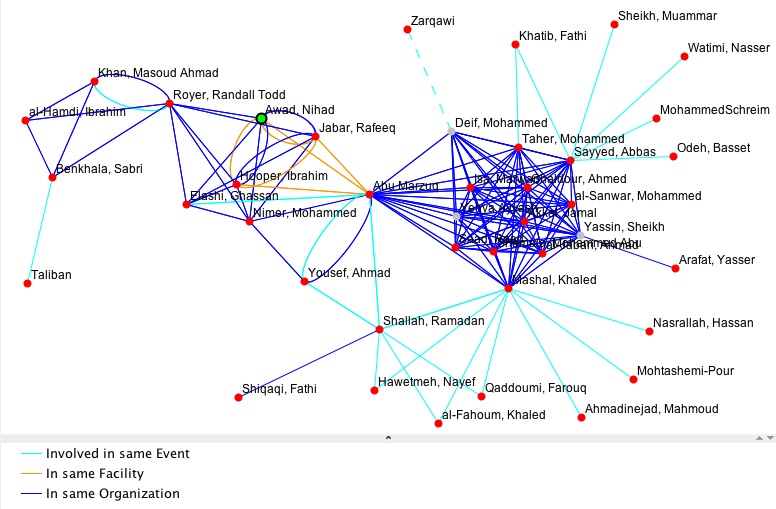
This network graph below is incomplete, but (hopefully) helps to illustrate the links between CAIR’s leadership, the (now defunct) IAP, and Hamas. The big dark blue tangle in the middle is Hamas’ leadership. The lighter blue lines represent contacts and meetings. Those coming off of Hamas Politburo chief Khaled Mashal show his meetings with leaders from other Palestinian movements and regional governments. The light blue lines in the upper right indicate the web of events behind the 2002 Passover Massacre suicide bombing. The broken line between Mohammed Deif (Hamas’ military chief) and Zarqawi indicate rumors that they were in contact. (For more on this graph and my work at the University of Maryland see the end of this entry.)

In this graph the yellow lines are critical - they indicate individuals sharing an affiliation with with IAP, including Abu Marzuq. The blue lines between several of those same individuals indicate their shared association with CAIR. The overlap between CAIR and IAP is tough to miss. Additionally, the light blue line between Abu Marzuq and Ghassan Elashi (head of CAIR’s Texas branch) indicates Abu Marzuq’s investment in Elashi’s company Infocom. (I didn’t have the energy to input the data surrounding the Infocom-Holy Land Relief Foundation operation.) Also, the group centered on former CAIR employee Randall Todd Royer are the “Virginia Jihad group” who played paintball and planned to link with the Pakistani terrorist group Lashkar-e-Toiba and possibly the Taliban. (Much more on CAIR and its links to radical Islamist activity in the U.S. and abroad can be read in CAIR: Islamists Fooling the Establishment by Daniel Pipes and Sharon Chadha,Middle East Quarterly, Spring 2006.)
Read More »
This slight degree of separation between a terrorist organization and self-described civil rights advocacy group makes it no surprise that CAIR was named an unindicted co-conspirator in the case against the Holy Land Foundation for Relief and Development. The fact that CAIR is basically funded by foreign sources (see the Pipes article cited above) puts it in the camp of the old Communist front organizations that the Soviet Union funded during the Cold War.
There are several important conclusions to be drawn here, beyond the obvious - that political leaders should shun CAIR. There is also the good news, the Washington Times reports that since 2000 CAIR’s membership has dropped from 29.000 to 1,700. American Muslims have effectively rejected CAIR’s bid to be their leader. This speaks well for the American Muslim community and its readiness to distance itself from those linked to terrorism.
But it is also a sharp reminder of Hamas’ ingenuity and global ambitions. That Hamas would start a U.S. propaganda arm like the IAP is unsurprising. That it would then spin off a “civil rights” organization that has taken on the broad mandate of shaping U.S. views towards Islam is an important reminder that Hamas is a sophisticated organization and, like Hezbollah, not simply a terrorist threat but also a capable political actor. Also, it shows that although Hamas ostensibly focuses on the Palestinian issue, it does share in the global ambitions of its parent organization – the Muslim Brotherhood. We forget these realities at our peril.
Hamas is now poised to take on an international role as the first Muslim Brotherhood state. It has already won an election and a war. Their opening gambits as Gaza’s rulers, the release of BBC journalist Alan Johnston and also the return of a lion kidnapped from the Gaza zoo, have been savvy. Hamas is portraying itself as a responsible player that can maintain order in the Gaza strip – unlike the deposed Fatah. If Hamas can play its cards well, it can establish itself as the a group with which “business can be done.” Achieving this kind of legitimacy will have a profound effect across the region where in most countries the Muslim Brotherhood or one of its offshoots is the primary opposition to the government. They have shown remarkable ingenuity – the establishment of CAIR is only one example – don’t bet against them.
About the Graph and My Research at the University of Maryland
You can view this graph live here: the nodes are navigable, but it takes a moment for the site to generate the graph.) A brief description of my dayjob using the Semantic Web to research terrorism is here. A short academic paper I wrote about it can be found here and the website (technically a Semantic Web terrorism research portal) is here. Quick caveat, the data on the site - which is very much research in progress - is less important than the underlying technology.
While I will continue on this project, I also have a new position (still with the University of Maryland) with the Laboratory for Computational Cultural Dynamics which seeks “to develop the theory and algorithms required for tools to support decision making in cultural contexts.” That is, we hope to develop computer systems that will help model how different cultures act and react in different situations. When these models are developed they can be applied to a range of issues including counter-insurgency, development, crime prevention, and disaster relief.
« Close It
July 13, 2007 12:53 AM
Link


 Posts
Posts




No comments:
Post a Comment