
Reflections from news and commentary of the day
Subscribe To


 Posts
All Comments
Posts
All Comments
Saturday, January 29, 2011


Egypt News and Commentary - Saturday
Days of Unrest
Anti-Government Protests Spread in Egypt - Voice of America
Egypt's Regime on the Brink - Wall Street Journal
Egypt Protests Continue as Government Resigns - New York Times
Cairo in Near Anarchy as Protesters Push to Oust President - Washington Post
Egypt's Anger Spills into Streets for a 5th Day - Los Angeles Times
Egypt Protests: Hosni Mubarak Faces Fifth 'Day of Rage' - BBC News
Mubarak Vows Cabinet Shift but Defends Deploying Army - New York Times
Egyptian Military Deploys as Protesters Defy Curfew - Washington Post
Egyptian President Dismisses Cabinet Following Massive Protests - VOA
Amid Massive Protests, Egypt Leader Fires Cabinet - Associated Press
New Clashes Erupt as Egyptians Spurn Mubarak Speech - Reuters
Egyptians’ Fury Smoldered Beneath Surface for Decades - New York Times
Egypt: President Obama's Remarks - Los Angeles Times
Obama Phones Mubarak, Urges Reforms - Voice of America
Obama Urges Egypt to Heed Protests, Pursue Reforms - Washington Post
Egypt: Obama Cautions Embattled Ally Against Violence - New York Times
Egyptian Military Chiefs Cut Pentagon Visit Short - New York Times
Before Uprising, Decades of Poverty and Resignation - Los Angeles Times
Egypt: A Nobelist Has an Unfamiliar Role in Protests - New York Times
Egyptian Hopes Converge in Fight for Cairo Bridge - New York Times
Chaos And Calm, Fury And Rejoicing Mark Egypt Protests - Reuters
In Alexandria, Protesters Rout the Police, for Now - New York Times
Egypt’s Military Is Seen as Pivotal in Next Step - New York Times
U.S. Backs Rights of Protesters in Mideast Upheaval - VOA
Egypt Protests: America's Secret Backing for Rebels - Daily Telegraph
Iran Sees Rise of Islamic Hard-Liners - New York Times
Al Jazeera Covers Protests Despite Hurdles - New York Times
Egypt Cuts Off Most Internet and Cell Service - New York Times
U.S. Warns Against Blocking Social Media - Washington Post
Complete Coverage: Unrest in Egypt - Stars and Stripes
Thousands Protest for Reform in Jordan - Voice of America
In Tunisia, Luxurious Lifestyles of the Corrupt - Washington Post
Protests Unsettle Jordan, Most Other Neighbors Stay Calm - New York Times
U.S. Needs to Break with Mubarak Now - Washington Post editorial
Washington and Mr. Mubarak - New York Times editorial
Cairo's Restless Streets - Los Angeles Times editorial
A New Beginning - Washington Post opinion
How Do You Solve a Problem Like Mubarak? - New York Times opinion
How to Respond - Washington Post opinion series
Anti-Government Protests Spread in Egypt - Voice of America
Egypt's Regime on the Brink - Wall Street Journal
Egypt Protests Continue as Government Resigns - New York Times
Cairo in Near Anarchy as Protesters Push to Oust President - Washington Post
Egypt's Anger Spills into Streets for a 5th Day - Los Angeles Times
Egypt Protests: Hosni Mubarak Faces Fifth 'Day of Rage' - BBC News
Mubarak Vows Cabinet Shift but Defends Deploying Army - New York Times
Egyptian Military Deploys as Protesters Defy Curfew - Washington Post
Egyptian President Dismisses Cabinet Following Massive Protests - VOA
Amid Massive Protests, Egypt Leader Fires Cabinet - Associated Press
New Clashes Erupt as Egyptians Spurn Mubarak Speech - Reuters
Egyptians’ Fury Smoldered Beneath Surface for Decades - New York Times
Egypt: President Obama's Remarks - Los Angeles Times
Obama Phones Mubarak, Urges Reforms - Voice of America
Obama Urges Egypt to Heed Protests, Pursue Reforms - Washington Post
Egypt: Obama Cautions Embattled Ally Against Violence - New York Times
Egyptian Military Chiefs Cut Pentagon Visit Short - New York Times
Before Uprising, Decades of Poverty and Resignation - Los Angeles Times
Egypt: A Nobelist Has an Unfamiliar Role in Protests - New York Times
Egyptian Hopes Converge in Fight for Cairo Bridge - New York Times
Chaos And Calm, Fury And Rejoicing Mark Egypt Protests - Reuters
In Alexandria, Protesters Rout the Police, for Now - New York Times
Egypt’s Military Is Seen as Pivotal in Next Step - New York Times
U.S. Backs Rights of Protesters in Mideast Upheaval - VOA
Egypt Protests: America's Secret Backing for Rebels - Daily Telegraph
Iran Sees Rise of Islamic Hard-Liners - New York Times
Al Jazeera Covers Protests Despite Hurdles - New York Times
Egypt Cuts Off Most Internet and Cell Service - New York Times
U.S. Warns Against Blocking Social Media - Washington Post
Complete Coverage: Unrest in Egypt - Stars and Stripes
Thousands Protest for Reform in Jordan - Voice of America
In Tunisia, Luxurious Lifestyles of the Corrupt - Washington Post
Protests Unsettle Jordan, Most Other Neighbors Stay Calm - New York Times
U.S. Needs to Break with Mubarak Now - Washington Post editorial
Washington and Mr. Mubarak - New York Times editorial
Cairo's Restless Streets - Los Angeles Times editorial
A New Beginning - Washington Post opinion
How Do You Solve a Problem Like Mubarak? - New York Times opinion
How to Respond - Washington Post opinion series
The Conflicts in Yemen and U.S. National Security by Dr. W. Andrew Terrill, U.S. Army War College's Strategic Studies Institute.
The Conflicts in Yemen and U.S. National Security by Dr. W. Andrew Terrill, U.S. Army War College's Strategic Studies Institute.
Why We Should Support Democratic Revolution in the Islamic World by Dr. Robert J. Bunker
Why We Should Support Democratic Revolution in the Islamic World
by Dr. Robert J. Bunker
Download The Full Article: Why We Should Support Democratic Revolution in the Islamic World
Recent events in Tunisia, Egypt, and Yemen have caught senior U.S. policymakers off guard like a herd of deer frozen in the headlights of a big rig barreling down the highway. The State Department contingency plan now appears to be to pretend to play the middle in the media—between the democratic yearnings of the mob and the longing looks of friendly despots— while privately clinging to principals of realpolitik. Calls for democratic freedoms and reforms to be implemented in Egypt, the true center of gravity for the Arab region, are being made but they are no more than hallow exaltations.
The U.S. has the bad habit of backing corrupt despots and the ruling families and elites that support them. Who can forget the Ngo family in South Vietnam, Shah Mohammad Reza Pahlavi of Iran, and General Manuel Noreiga in Panama? As long as this general or that ruler is willing to back our foreign policies in the region of concern, we turn a blind eye to inequality, authoritarianism, torture, rigged voting, and other abuses. If they should dare to cross us, however, then all bets are off and they may just find themselves dead or rotting in a jail cell for the rest of their lives. International relations is much like a knife fight— outside help is always welcome, little thought is given to the baggage that may come with offers of support, and you had always better watch your back. Ultimately, these friendly despots and their cronies are ‘not our friends’ and definitely not ‘legitimately elected leaders’. We also tend to get morally tainted by our relations with these types; not that our silver-tongued diplomats would give this a second thought. Realpolitik requires sacrifices and morality quickly becomes relative and squishy to the policy being implemented or crisis now at hand.
Download The Full Article: Why We Should Support Democratic Revolution in the Islamic World
Dr. Robert J. Bunker is a frequent contributor to Small Wars Journal. He has over 200 publications including Non-State Threats and Future Wars (editor); Networks, Terrorism and Global Insurgency (editor); Criminal-States and Criminal-Soldiers (editor); and Narcos Over the Border (editor). He can be reached at bunker@usc.edu.
by Dr. Robert J. Bunker
Download The Full Article: Why We Should Support Democratic Revolution in the Islamic World
Recent events in Tunisia, Egypt, and Yemen have caught senior U.S. policymakers off guard like a herd of deer frozen in the headlights of a big rig barreling down the highway. The State Department contingency plan now appears to be to pretend to play the middle in the media—between the democratic yearnings of the mob and the longing looks of friendly despots— while privately clinging to principals of realpolitik. Calls for democratic freedoms and reforms to be implemented in Egypt, the true center of gravity for the Arab region, are being made but they are no more than hallow exaltations.
The U.S. has the bad habit of backing corrupt despots and the ruling families and elites that support them. Who can forget the Ngo family in South Vietnam, Shah Mohammad Reza Pahlavi of Iran, and General Manuel Noreiga in Panama? As long as this general or that ruler is willing to back our foreign policies in the region of concern, we turn a blind eye to inequality, authoritarianism, torture, rigged voting, and other abuses. If they should dare to cross us, however, then all bets are off and they may just find themselves dead or rotting in a jail cell for the rest of their lives. International relations is much like a knife fight— outside help is always welcome, little thought is given to the baggage that may come with offers of support, and you had always better watch your back. Ultimately, these friendly despots and their cronies are ‘not our friends’ and definitely not ‘legitimately elected leaders’. We also tend to get morally tainted by our relations with these types; not that our silver-tongued diplomats would give this a second thought. Realpolitik requires sacrifices and morality quickly becomes relative and squishy to the policy being implemented or crisis now at hand.
Download The Full Article: Why We Should Support Democratic Revolution in the Islamic World
Dr. Robert J. Bunker is a frequent contributor to Small Wars Journal. He has over 200 publications including Non-State Threats and Future Wars (editor); Networks, Terrorism and Global Insurgency (editor); Criminal-States and Criminal-Soldiers (editor); and Narcos Over the Border (editor). He can be reached at bunker@usc.edu.
Simon Johnson | Davos: Two Worlds, Ready or Not
Simon Johnson | Davos: Two Worlds, Ready or Not
Simon Johnson, The Baseline Scenario: "On the fringes of the World Economic Forum meeting in Davos this week, there was plenty of substantive discussion - including about the dangers posed by our 'too big to fail'/'too big to save' banks, the consequences of widening inequality (reinforced by persistent unemployment in some countries), and why the jobs picture in the US looks so bad. But in the core keynote events and more generally around any kind of CEO-related interaction, such themes completely failed to resonate. There is, of course, variation in views across CEOs and the people work intellectual agendas on their behalf, but still the mood among this group was uniformly positive - it was hard to detect any note of serious concern."
Read the Article
Simon Johnson, The Baseline Scenario: "On the fringes of the World Economic Forum meeting in Davos this week, there was plenty of substantive discussion - including about the dangers posed by our 'too big to fail'/'too big to save' banks, the consequences of widening inequality (reinforced by persistent unemployment in some countries), and why the jobs picture in the US looks so bad. But in the core keynote events and more generally around any kind of CEO-related interaction, such themes completely failed to resonate. There is, of course, variation in views across CEOs and the people work intellectual agendas on their behalf, but still the mood among this group was uniformly positive - it was hard to detect any note of serious concern."
Read the Article
Will Mubarak Heed Obama's Call to Listen to Protesters?
Will Mubarak Heed Obama's Call to Listen to Protesters?
Warren P. Strobel and Jonathan S. Landay, McClatchy Newspapers: "President Barack Obama dramatically increased pressure Friday on Egyptian President Hosni Mubarak to overhaul the political system in response to nationwide protests, telling Mubarak it's time to open 'a meaningful dialogue' with his opponents.... Obama's remarks were the most blunt from the US government since the protests began Tuesday, and suggested that Mubarak's days in power could be numbered following the worst violence in 60 years."
Read the Article
Warren P. Strobel and Jonathan S. Landay, McClatchy Newspapers: "President Barack Obama dramatically increased pressure Friday on Egyptian President Hosni Mubarak to overhaul the political system in response to nationwide protests, telling Mubarak it's time to open 'a meaningful dialogue' with his opponents.... Obama's remarks were the most blunt from the US government since the protests began Tuesday, and suggested that Mubarak's days in power could be numbered following the worst violence in 60 years."
Read the Article
Fear Extreme Islamists in Egypt and the Arab World? Blame Washington
Fear Extreme Islamists in Egypt and the Arab World? Blame Washington
Jeff Cohen, Truthout: "For decades beginning during the Cold War, US policy in the Islamic world has been aimed at suppressing secular reformist and leftist movements. Beginning with the CIA-engineered coup against a secular democratic reform government in Iran in 1953 (it was about oil), Washington has propped up dictators, coaching these regimes in the black arts of torture and mayhem against secular liberals and the left.... One of the mantras on US television news all day Friday was: Be fearful of the democratic uprisings against US allies in Egypt (and Tunisia and elsewhere). After all, we were told by Fox News and CNN and Chris Matthews on MSNBC, it could end up as bad as when 'our ally' in Iran was overthrown and the extremists came to power in 1979."
Read the Article
Jeff Cohen, Truthout: "For decades beginning during the Cold War, US policy in the Islamic world has been aimed at suppressing secular reformist and leftist movements. Beginning with the CIA-engineered coup against a secular democratic reform government in Iran in 1953 (it was about oil), Washington has propped up dictators, coaching these regimes in the black arts of torture and mayhem against secular liberals and the left.... One of the mantras on US television news all day Friday was: Be fearful of the democratic uprisings against US allies in Egypt (and Tunisia and elsewhere). After all, we were told by Fox News and CNN and Chris Matthews on MSNBC, it could end up as bad as when 'our ally' in Iran was overthrown and the extremists came to power in 1979."
Read the Article
Will Egypt's Military Officers Free the Revolution?
Will Egypt's Military Officers Free the Revolution?
Misr/Egypt in 140 characters or less
"Freedom of the press is guaranteed only to those who own one."
Misr/Egypt in 140 characters or less
Blowback Good riddance, 'peace process'
Blowback
Good riddance, 'peace process'
Don't lament the end of negotiations that put Israeli demands, backed
almost unconditionally by the U.S. and at the expense of basic
Palestinian rights, first and foremost.
By Josh Ruebner
The Los Angeles Times
Good riddance, 'peace process'
Don't lament the end of negotiations that put Israeli demands, backed
almost unconditionally by the U.S. and at the expense of basic
Palestinian rights, first and foremost.
By Josh Ruebner
The Los Angeles Times
Former elite officers reveal tensions in Iran regime
Former elite officers reveal tensions in Iran regime
Men describe measures taken to crush popular protests that erupted in the wake of last year's presidential elections
Look for new links across the global south By Luis Alberto Moreno
Look for new links across the global south
By Luis Alberto MorenoInequality In America Is Worse Than In Egypt, Tunisia Or Yemen
Guest Post: Inequality In America Is Worse Than In Egypt, Tunisia Or Yemen
→ Washington’s BlogEgyptian, Tunisian and Yemeni protesters all say that inequality is one of the main reasons they’re protesting.
However, the U.S. actually has much greater inequality than in any of those countries.
Specifically, the “Gini Coefficient” – the figure economists use to measure inequality – is higher in the U.S.
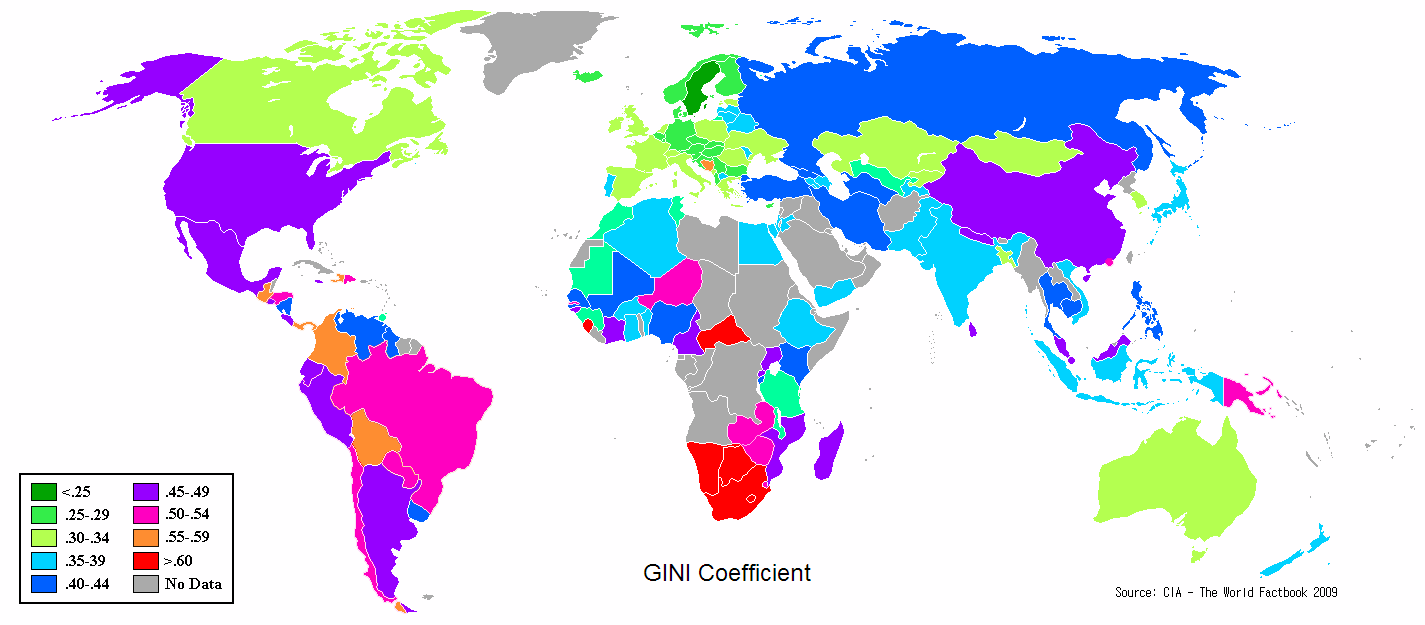
Gini Coefficients are like golf – the lower the score, the better (i.e. the more equality).
According to the CIA World Fact Book, the U.S. is ranked as the 42nd most unequal country in the world, with a Gini Coefficient of 45.
In contrast:
- Tunisia is ranked the 62nd most unequal country, with a Gini Coefficient of 40.
- Yemen is ranked 76th most unequal, with a Gini Coefficient of 37.7.
- And Egypt is ranked as the 90th most unequal country, with a Gini Coefficient of around 34.4.
So why are Egyptians rioting, while the Americans are complacent?
Well, Americans – until recently – have been some of the wealthiest
people in the world, with most having plenty of comforts (and/or
entertainment) and more than enough to eat.
But another reason is that – as Dan Ariely of Duke University and Michael I. Norton of Harvard Business School demonstrate – Americans consistently underestimate the amount of inequality in our nation.
As William Alden wrote last September:
Americans vastly underestimate the degree of wealth inequality in America, and we believe that the distribution should be far more equitable than it actually is, according to a new study.Here’s the study.
Or, as the study’s authors put it: “All demographic groups — even those not usually associated with wealth redistribution such as Republicans and the wealthy — desired a more equal distribution of wealth than the status quo.”
The report … “Building a Better America — One Wealth Quintile At A Time” by Dan Ariely of Duke University and Michael I. Norton of Harvard Business School … shows that across ideological, economic and gender groups, Americans thought the richest 20 percent of our society controlled about 59 percent of the wealth, while the real number is closer to 84 percent.
After Egypt, Will U.S. Get 'Internet Kill Switch'? -- PC Magazine
After Egypt, Will U.S. Get 'Internet Kill Switch'? -- PC Magazine
With reports of Egypt's government completing shutting down the Internet in the country, talk about an "Internet kill switch" bill in the U.S. has reemerged. Could it happen here?
The bill in question is the Protecting Cyberspace as a National Asset Act of 2010, a cyber-security measure introduced in June by Sen. Joseph Lieberman. It was an over-arching cyber-security measure that, among other things, would create an office of cyberspace policy within the White House and a new cyber-security center within the Homeland Security Department.
Read more ....
Internet ‘Kill Switch’ Legislation Back in Play -- Threat Level
Zombie internet 'kill switch' bill back to haunt the Senate -- Washington Examiner
How Governments Flip the Internet’s Kill Switch -- New York Magazine
So how do you shut off a whole nation's Internet? -- MSNBC
Could Egypt Happen Here? Obama's Internet "Kill Switch" -- Fast Company
Internet Kill Switch: Should the United States Emulate Egypt? -- Aol News
What Could Possibly Go Wrong: An Internet "Off" Switch -- Popular Science
Tunisia, Egypt, Miami: The Importance of Internet Choke Points -- The Atlantic
Egypt's 'Net Shutdown a Wakeup Call for Companies -- PC World
With reports of Egypt's government completing shutting down the Internet in the country, talk about an "Internet kill switch" bill in the U.S. has reemerged. Could it happen here?
The bill in question is the Protecting Cyberspace as a National Asset Act of 2010, a cyber-security measure introduced in June by Sen. Joseph Lieberman. It was an over-arching cyber-security measure that, among other things, would create an office of cyberspace policy within the White House and a new cyber-security center within the Homeland Security Department.
Read more ....
Internet ‘Kill Switch’ Legislation Back in Play -- Threat Level
Zombie internet 'kill switch' bill back to haunt the Senate -- Washington Examiner
How Governments Flip the Internet’s Kill Switch -- New York Magazine
So how do you shut off a whole nation's Internet? -- MSNBC
Could Egypt Happen Here? Obama's Internet "Kill Switch" -- Fast Company
Internet Kill Switch: Should the United States Emulate Egypt? -- Aol News
What Could Possibly Go Wrong: An Internet "Off" Switch -- Popular Science
Tunisia, Egypt, Miami: The Importance of Internet Choke Points -- The Atlantic
Egypt's 'Net Shutdown a Wakeup Call for Companies -- PC World
The Dissolving Constitution The Enumerated Rights Are Hanging By A Thread by Paul Craig Roberts
The Dissolving Constitution
The Enumerated Rights Are Hanging By A Thread
by Paul Craig Roberts
The Enumerated Rights Are Hanging By A Thread
by Paul Craig Roberts
Friday, January 28, 2011
Obama "Internet Kill Switch" Plan Approved by US Senate Panel
Obama "Internet Kill Switch" Plan Approved by US Senate Panel
Read the Article at TechWorld
Read the Article at TechWorld
Mohamed ElBaradei: "If Not Now, When?"
Mohamed ElBaradei: "If Not Now, When?"
Robert Naiman, Truthout: "If Western leaders, who have backed the dictator Mubarak for 30 years, cannot stand before the Egyptian people today and say unequivocally, 'we support your right of national self-determination,' when can they do it? That's the question that Egyptian democracy leader and Nobel laureate Mohamed ElBaradei has put before Western leaders today."
Read the Article
Robert Naiman, Truthout: "If Western leaders, who have backed the dictator Mubarak for 30 years, cannot stand before the Egyptian people today and say unequivocally, 'we support your right of national self-determination,' when can they do it? That's the question that Egyptian democracy leader and Nobel laureate Mohamed ElBaradei has put before Western leaders today."
Read the Article
America's Continuing Misadventures in the Middle East
Several people have asked me to post this recording of Steve Clemons and Chas Freeman's conversation on this topic at the New America Foundation two days ago. http://middleeast.newamerica.
Report: Mubarak announces he is dismissing the government
Report: Mubarak announces he is dismissing the government
by CalculatedRisk on 1/28/2011 05:45:00 PM
From Al Jazeera English Mubarak announces he is dismissing the governmentUpdate: From the NY Times: Mubarak Orders Ministers to Resign but Backs Armed Response to Egypt Protests
Subscribe to:
Posts (Atom)